
Buying Off-Plan Property in Dubai in 2026: The Complete Process, Cost and Return Guide

Off-plan is no longer the speculative corner of Dubai’s market. It is the market. In the first half of 2026, off-plan properties accounted for 71% of all real estate transactions in the emirate, with off-plan sales alone reaching AED 139.75 billion across 58,840 deals. If you are weighing a purchase, the question is no longer whether off-plan is credible, but how to buy it correctly. Why off-plan dominates Dubai in 2026 Dubai recorded roughly AED 419.9 billion in total real estate transactions across 112,850 transactions in H1 2026. Q1 alone delivered AED 252 billion, up 31% year on year in value and 6% in volume. Average prices rose about 9% over the half, and foreign investment reached AED 148.35 billion in Q1, up 26%. Three structural forces sit behind this. Payment plans spread cost over three to five years instead of demanding full capital upfront. Launch pricing typically sits below comparable ready stock. And the regulatory frame, built on escrow accounts and construction-linked disbursement overseen by the Dubai Land Department and RERA, has removed most of the risk that defined earlier cycles. The demand base has widened, not narrowed Q1 2026 brought 29,312 first-time investors into the market, a 14% increase. Commercial property told the same story from a different angle: AED 19.5 billion across 3,415 deals in H1, a 183% jump in value, with average deal size nearly doubling to AED 5.7 million. How the off-plan buying process works Step 1: Verify the developer before you look at floor plans Project quality varies far more than brochures suggest. Check three things. The escrow account Every registered off-plan project must hold buyer funds in a DLD-supervised escrow account, released to the developer against verified construction milestones. No escrow, no purchase. The Trakheesi permit and project registration Off-plan projects require a Trakheesi advertising permit, and any agent marketing to you must hold a valid RERA BRN. Ask for both numbers and verify them in the Dubai REST app. Our guide on how to choose a real estate broker in Dubai covers the full verification check. Delivery history is the strongest single signal Look at what the developer handed over in the last three years, not what it has announced. On-time delivery record, snagging quality and service charge levels at completed towers tell you more than any render. Step 2: Reservation form and SPA You sign a reservation form, pay a booking amount (commonly 5% to 20%), then execute the Sales and Purchase Agreement. The SPA must be registered with the DLD within 60 days. Off-plan contracts carry a five-day cooling-off right, so read the completion date, delay clause and penalty terms in that window. Step 3: Oqood registration and the payment plan Off-plan title is recorded through an Oqood certificate rather than an immediate title deed. Instalments follow construction milestones. Post-handover plans, where 30% to 40% falls due after you take possession, have become common and materially change your cash flow model. Step 4: Handover and title transfer At completion you settle the balance, complete snagging, connect DEWA, and the Oqood converts to a title deed. What buying actually costs Government and transaction fees The DLD transfer fee is 4% of the purchase price, the single largest acquisition cost, and it applies identically to UAE nationals, residents and foreign buyers. Add registration fees of roughly AED 2,100 to AED 4,200 depending on value, a title deed fee of about AED 580, and agency commission of around 2% on secondary transactions. All in, budget 6% to 8% above the headline price. If you are buying remotely, a notarised Power of Attorney typically costs AED 1,000 to AED 2,000. Mortgage position Financing off-plan is harder than financing ready stock, and most off-plan purchases are funded through the developer payment plan instead. Where a Dubai mortgage applies, UAE residents can generally access up to 80% loan-to-value, while non-residents face a materially tighter cap, commonly around 50%, with a minimum 35% down payment on ready property. Mortgage registration costs 0.25% of the loan plus AED 290. The returns you should underwrite Dubai’s average rental yield sat at approximately 6.68% as of April 2026, with apartments averaging 7.15%. By community, JVC, Arjan and Dubai Silicon Oasis lead on gross yield at roughly 8% to 9%, Dubai Marina and Business Bay sit near 5.5% to 7.5%, and Downtown Dubai runs 4% to 6%. Gross yield is not the number that matters. Service charges of AED 10 to AED 32 per square foot per year, plus a realistic void allowance of 5% to 8% in prime areas and 8% to 12% in higher-turnover communities, mean a 9% gross yield in a mid-market building typically settles near 5.5% to 6.5% net. Underwriting at full occupancy is the most common modelling error we see. Rules for foreign and non-resident investors Foreign nationals hold 100% freehold title in designated freehold zones, with no restriction by nationality and no additional transfer tax. Dubai levies no annual property tax and no capital gains tax on residential sales. Property investment at AED 2 million or above qualifies for the Golden Visa. Short-term letting requires a DTCM holiday home permit, covered in our guide to property management services in Dubai. Off-plan or ready: how to choose Choose off-plan for staged payments, launch pricing and appreciation through the build period. Choose ready if you need rental income from month one, need mortgage financing, or want to inspect the exact unit. With well over 100,000 units on announced 2026 schedules, both routes remain competitively priced. Browse our Dubai property listings or request a free property valuation to benchmark a specific unit. Frequently Asked Questions Can foreigners buy off-plan property in Dubai? Yes. Foreign nationals, resident or not, can buy freehold off-plan property in designated freehold zones with no nationality restriction and no additional fee compared with UAE nationals. What deposit do I need for off-plan property in Dubai? Booking amounts typically run 5% to 20% of the purchase price, followed by construction-linked instalments.
15 Best Areas to Stay in Dubai for Families, Professionals & Property Investors

Looking for a good area to stay in Dubai? This guide covers 15 top Dubai communities for families, working professionals, and property investors. Find out where to live in Dubai based on your lifestyle, budget, and goals. Dubai has something for everyone. Dubai is a city of choices. Every neighborhood has its own charm. Some are quiet and green. Others are busy and full of energy. So, how do you find a good area to stay in Dubai that actually fits your life? This guide makes it simple. We have listed the 15 best areas in Dubai for families, professionals, and investors. Whether you want peaceful streets, a short commute, or strong rental returns, there is a place here for you. You can also browse our full list of neighborhoods for a closer look at each community. Why Choosing the Right Neighborhood Matters Your address shapes your daily life. It affects your commute, your budget, and your happiness. That is why picking the right Dubai neighborhoods is such an important step. A good area to stay in Dubai should match your needs, not just your budget. Let’s explore the top options. Best Family Areas Dubai Families need space, safety, and good schools. These family areas Dubai offer all three. For a deeper look at schools and lifestyle by community, see our guide to the best family-friendly communities in Dubai 2026. 1. Arabian Ranches This community is known for its villas and quiet streets. There are parks, schools, and golf courses nearby. Families love the peaceful setting here. 2. Mirdif Mirdif is affordable and friendly. It has spacious homes, green parks, and a strong sense of community. It is a good area to stay in Dubai if you want a relaxed lifestyle. 3. Jumeirah Village Circle (JVC) JVC offers value for money. It has parks, pools, and easy access to main roads. Many young families choose this spot. 4. The Springs This gated community has lakes and walking trails. It feels calm, yet it is close to the city. It is one of the most popular Dubai communities for families with kids. 5. Al Barsha Al Barsha is central and convenient. It has schools, malls, and hospitals nearby. This makes daily life much easier for busy parents. Best Areas for Professionals If you work in the city, your commute matters a lot. These spots are ideal if you are wondering where to live in Dubai as a working professional. 6. Business Bay This area sits close to Downtown Dubai. It has modern apartments and a short commute to major offices. Many professionals call this a good area to stay in Dubai because of its central location. 7. Downtown Dubai Home to the Burj Khalifa, this area buzzes with energy. It suits people who enjoy city life and want to be near work and entertainment. Explore current listings in Downtown among our featured neighborhoods. 8. Dubai Marina This waterfront community is popular with young professionals. It has a lively nightlife, walking paths, and great views. It remains one of the best areas in Dubai for singles and couples alike. See our Dubai Marina listings for available options. 9. Jumeirah Lake Towers (JLT) JLT offers affordable apartments close to the Marina. It has a good mix of offices and homes, making it convenient for daily commutes. 10. Al Quoz Known for its creative spaces, Al Quoz is growing fast. It suits professionals in art, media, and design industries. Best Areas for Property Investors Investors look for growth and strong rental demand. These Dubai neighborhoods stand out for smart investment choices. Our guide to the highest rental yield areas in Dubai 2026 breaks down returns across the city in more detail. 11. Dubai Hills Estate This community mixes villas, apartments, and green spaces. Property values here keep rising steadily. It is a solid pick for long-term investment. Browse current Dubai Hills Estate options. 12. Dubai South Close to the airport and Expo City, this area is developing quickly. Prices remain affordable, which makes it attractive for investors. 13. Jumeirah Beach Residence (JBR) JBR offers beachfront living and strong rental income. Tourists and residents both want to stay here, which keeps demand high. 14. Palm Jumeirah This iconic island offers luxury villas and apartments. It attracts high-end buyers and renters. It remains one of the best areas in Dubai for premium investment. View available Palm Jumeirah properties. 15. Al Furjan Al Furjan is a rising star. It offers modern townhouses at reasonable prices. As infrastructure improves, so does its investment potential. For more emerging communities like this, check our full new developments page. How to Pick the Right Neighborhood for You Finding a good area to stay in Dubai depends on your priorities. First, think about your budget. Then, consider your commute. After that, look at schools, parks, and lifestyle options nearby. If you’re also weighing whether to rent or buy in your chosen area, our rent vs buy 2026 guide can help. For example, families may prefer quiet Dubai communities like Arabian Ranches or Mirdif. On the other hand, professionals might choose Business Bay or Dubai Marina for shorter commutes. Meanwhile, investors often look toward Dubai Hills Estate or Dubai South for future growth. In short, there is no single right answer. It all depends on what matters most to you. Our team can help you narrow down the right community once you know your priorities. Final Thoughts Dubai offers endless options. From peaceful family areas Dubai to buzzing city hubs, there is truly something for everyone. Take your time. Visit a few neighborhoods before deciding. This way, you will find a good area to stay in Dubai that truly feels like home. Learn more about how we help clients find the right fit on our About Us page, or explore our services for buyers, sellers, and investors. Frequently Asked Questions 1. What is the most good area to stay in Dubai for families? Arabian Ranches and Mirdif are both excellent choices. They
Dubai Hills Estate vs Dubai Creek Harbour: Which Community Should You Invest In?
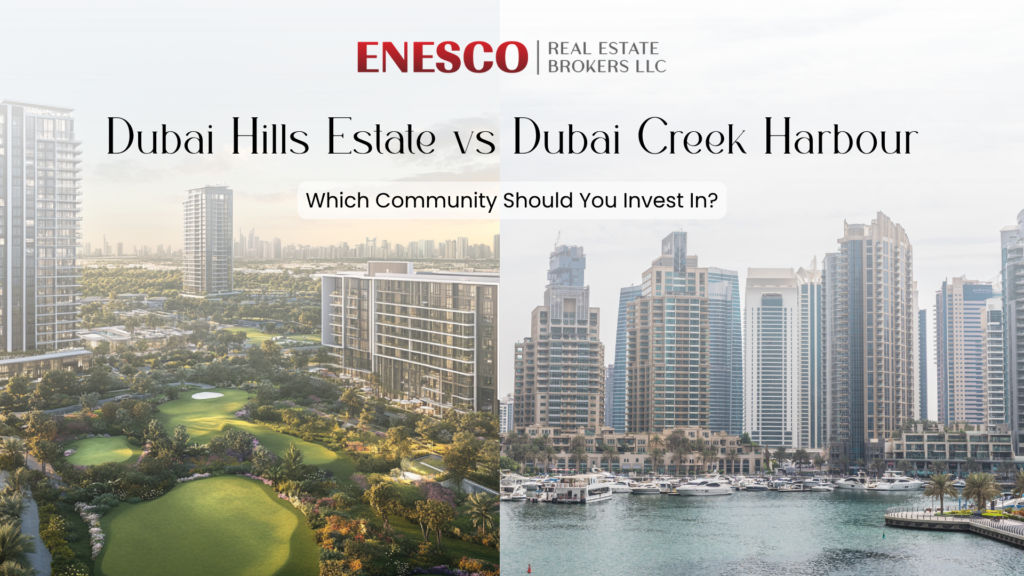
Dubai Hills Estate or Dubai Creek Harbour? Two of Dubai’s hottest communities go head-to-head. Find out which one fits your investment goals best. Dubai’s property market keeps growing every year. New buyers and investors are always searching for the best community in Dubai to put their money into. Two names come up again and again: Dubai Hills Estate and Dubai Creek Harbour. Both are popular. Both are beautiful. But they are very different from each other. So, which one should you choose? Let’s break it down in simple terms. What Makes Dubai Hills Estate Special? Dubai Hills Estate is a green, family-friendly community. It sits between Downtown Dubai and Dubai Marina. This central location makes it easy to reach almost anywhere in the city. The area is known for its huge golf course, wide parks, and quiet streets. Families love it because of the schools, hospitals, and shopping malls inside the community. If you enjoy a calm, green lifestyle but still want to stay close to the city buzz, Dubai Hills Estate fits perfectly. For a wider look at communities like this, see our guide to the best family-friendly communities in Dubai 2026. Many buyers also look for Dubai Hills Estate villas. These villas come with private gardens, spacious layouts, and modern designs. They are ideal for families who want more space and privacy compared to apartment living. Dubai Hills Estate Price: What to Expect The Dubai Hills Estate price varies depending on the property type. Apartments are more affordable and attract young professionals or small families. Villas, on the other hand, come at a higher price because of their size and premium finishes. Overall, prices here are considered reasonable for the quality of life offered. Compared to other luxury areas, Dubai Hills Estate gives buyers strong value. That said, prices have been rising steadily. This makes it a smart pick for anyone thinking about long-term investment. Browse our current new developments to compare pricing across other communities too. What About Dubai Creek Harbour? Dubai Creek Harbour is a newer waterfront community. It sits along the historic Dubai Creek, close to Ras Al Khor Wildlife Sanctuary. This area offers stunning views of the Dubai skyline and the creek itself. Unlike Dubai Hills Estate, Creek Harbour has a more futuristic feel. Tall towers, modern architecture, and waterfront promenades define the area. It’s also home to the upcoming Dubai Creek Tower, which is expected to be even taller than the Burj Khalifa. This community mostly offers apartments rather than villas. So, if you prefer high-rise living with skyline views, Dubai Creek Harbour might suit you better. Comparing Location and Connectivity Location plays a huge role in property value. Dubai Hills Estate is centrally located. It connects easily to Sheikh Zayed Road, making commutes to Downtown Dubai or Dubai Marina quick and simple. Dubai Creek Harbour, meanwhile, is a bit further from the main business hubs. However, it’s growing fast, and new roads and transport links are being added. In the coming years, connectivity here is expected to improve significantly. For now, Dubai Hills Estate has the edge in terms of daily convenience. But Dubai Creek Harbour offers something unique: a peaceful, nature-close setting with skyline views most areas can’t match. Lifestyle and Community Vibe If you’re raising a family, Dubai Hills Estate feels more suited to that lifestyle. There are parks, walking trails, schools, and a large mall right in the community. Life here feels relaxed and spacious. Dubai Creek Harbour, on the other hand, attracts young professionals and couples. The vibe is more urban and modern. Waterfront cafes, jogging tracks, and boutique shops give it a trendy feel. It’s perfect for those who enjoy city energy mixed with nature views. Investment Potential: Which One Wins? Both communities show strong investment potential, but for different reasons. Our guide to the highest rental yield areas in Dubai 2026 breaks down how these and other communities compare on returns. Dubai Hills Estate has already established itself as one of the best community in Dubai for families. Its steady demand keeps property values growing. Because it’s closer to completion, there’s less construction risk. What you see is mostly what you get. Dubai Creek Harbour, however, is still developing. This means prices are currently more flexible, and early investors could see bigger returns once the area is fully built. The upcoming Dubai Creek Tower alone could boost property values once construction finishes. So, if you want stability and steady growth, Dubai Hills Estate is the safer bet. If you’re comfortable with some risk for potentially higher rewards, Dubai Creek Harbour could pay off well. If you’re still deciding between renting and buying in either community, our rent vs buy 2026 guide can help. Final Thoughts: Which Should You Choose? There’s no single right answer. It depends on your goals. Choose Dubai Hills Estate if you want a family-friendly lifestyle, immediate rental income, and a proven track record. Choose Dubai Creek Harbour if you’re drawn to skyline views, modern living, and long-term growth potential. Either way, both communities represent smart, promising options in Dubai’s growing real estate market. Take your time, compare your budget, and pick the one that matches your lifestyle and investment goals best. Speak with our team for a personalized comparison, or learn more about how we work on our About Us page. Quick Answers to Common Questions 1. Is Dubai Hills Estate a good investment? Yes. Dubai Hills Estate offers steady demand, strong rental returns, and a central location, making it a reliable investment choice. 2. What is the average Dubai Hills Estate price for villas? Villa prices vary based on size and design, but they generally sit in the mid-to-high range compared to other Dubai communities. Browse our current new developments for up-to-date pricing. 3. Are Dubai Hills Estate villas suitable for families? Absolutely. The villas offer spacious layouts, private gardens, and access to schools, parks, and healthcare facilities nearby. 4. How far is Dubai Creek Harbour from Downtown Dubai? It’s
Rent vs Buy in Dubai 2026: Which Makes More Financial Sense Right Now?

Buying property in Dubai makes more financial sense for residents planning to stay for five years or longer, particularly when mortgage payments are comparable to annual rental costs. Renting remains the smarter option for those seeking flexibility, short-term residency, or lower upfront commitments. In 2026, rising rental prices, accessible mortgage options, and Dubai’s tax-efficient property market have shifted the equation toward ownership for many long-term residents. The reality is that there is no universal answer. The better choice depends on: This guide breaks down the real numbers, hidden costs, advantages, and risks to help you decide whether renting or buying makes more financial sense in Dubai in 2026. Introduction: Why the Rent vs Buy Debate Matters More Than Ever Over the past few years, Dubai’s residential market has undergone significant changes. Property values have appreciated across many communities. Rental rates have increased substantially. Mortgage accessibility has improved. Long-term residency pathways have become more attractive. As a result, many residents who previously viewed renting as the obvious choice are now reconsidering homeownership. The key question is no longer simply “Can I buy?” The question is: “Does buying make better financial sense than renting?” For many residents in 2026, the answer is increasingly yes. But only under the right circumstances. At a Glance: Rent vs Buy Comparison Factor Renting Buying Initial Cost Low Higher Flexibility High Moderate Monthly Commitment Fixed Rent Mortgage + Fees Equity Building None Yes Property Appreciation No Benefit Potential Benefit Maintenance Responsibility Usually Landlord Owner Long-Term Wealth Creation Limited Significant Potential Golden Visa Eligibility No Potentially Yes Best For Short-Term Residents Long-Term Residents Understanding the True Cost of Renting in Dubai Many people focus only on annual rent. However, renting involves additional expenses that accumulate over time. Typical rental costs include: Annual rent, Security deposit, Agency fees, Moving costs, Utility setup fees, Rent increases upon renewal. For example: A tenant paying AED 110,000 annually for a one-bedroom apartment may spend AED 110,000 rent, AED 5,000–7,000 agency fees, AED 5,000 security deposit, and utility deposits and setup charges. Over five years, the total expenditure can exceed AED 550,000 without building any ownership stake. The benefit is flexibility. The drawback is that every payment is an expense rather than an investment. Park Heights and Park Point – the most established apartment clusters – deliver the strongest yields in the community. Park Point in particular has been cited as achieving close to 6.97% gross yield on 1-bedroom units, driven by its proximity to Dubai Hills Park and the hospital. Understanding the Real Cost of Buying Property Buying property involves higher upfront costs but creates ownership. Typical purchase expenses include: Down Payment: Typically 20% for eligible properties, though higher percentages may apply depending on the property’s value and financing structure. Registration and Transfer Fees: Buyers should budget for property registration fees, transfer fees, and other administrative charges associated with the purchase. <strongstyle=”color:#181818 ;font-weight:700;font-family:Questrial, sans-serif;”>Mortgage Costs: Additional expenses may include bank processing fees, property valuation charges, and mandatory insurance requirements. Service Charges: Property owners are responsible for annual building and community maintenance fees, which vary based on the property type, community, and amenities provided. Although ownership involves additional expenses, part of every mortgage payment contributes toward building equity. Whether you’re browsing property for sale in UAE Dubai for the first time or comparing several options, understanding these costs upfront avoids surprises later. Financial Comparison: Renting vs Buying a One-Bedroom Apartment Renting: For a property with an equivalent value of AED 1.5 million, the annual rent is approximately AED 110,000, resulting in a total five-year cost of AED 550,000+. After five years, the tenant does not build any ownership or equity in the property. Buying: For a property valued at AED 1.5 million, the required down payment is approximately AED 300,000 (20%). Mortgage payments are generally comparable to annual rental expenses, depending on the financing terms. After five years, the buyer has accumulated significant equity, may benefit from property appreciation, and can choose to sell the property or retain it as an income-producing asset. The critical difference is that a portion of ownership costs contributes toward an asset rather than being purely an expense. When Renting Makes More Financial Sense You Plan to Stay Less Than Three Years: Transaction costs associated with buying and selling can outweigh ownership benefits over short time horizons. Your Employment Situation Is Uncertain: If relocation is likely, the flexibility of renting becomes more valuable. You Need Maximum Mobility: Many professionals prefer the freedom to change neighborhoods or cities without selling an asset. You Have Limited Capital: Buying requires significant upfront funds that could potentially be invested elsewhere. In these scenarios, renting provides financial flexibility and lower commitment. When Buying Makes More Financial Sense You Plan to Stay Five Years or More: Longer holding periods allow owners to spread acquisition costs over time. You Want to Build Equity: Mortgage payments gradually increase ownership in a tangible asset. You Have Stable Income: Predictable income improves affordability and reduces financing risk. You Want Long-Term Wealth Creation: Property ownership combines potential appreciation, equity accumulation, and rental income opportunities. These benefits are unavailable to renters. The Hidden Advantage Most People Ignore Many residents compare rent payments directly with mortgage payments. However, the more important comparison is Expense vs Asset Creation. A tenant paying AED 120,000 annually spends AED 600,000 over five years. At the end of five years: no ownership, no equity, no appreciation benefit. An owner paying similar annual costs may finish the same period with property ownership, built equity, potential appreciation gains, and future rental income opportunities. This distinction often becomes the most important factor in long-term financial planning. What About Property Appreciation? One major advantage of ownership is exposure to market growth. Property owners benefit when values rise. Renters do not. Although appreciation is never guaranteed, well-positioned communities often benefit from infrastructure improvements, population growth, increased demand, and community maturity. Over longer holding periods, appreciation can significantly enhance total returns. This is one reason many investors view homeownership as
Highest Rental Yield Areas in Dubai 2026: Where to Invest for Maximum Returns

The highest rental yield areas in Dubai in 2026 are Jumeirah Village Circle (JVC), Dubai South, Arjan, Dubai Silicon Oasis (DSO), and International City – delivering gross yields between 7.5% and 10% on well-positioned apartments. DAMAC Hills 2 and Al Furjan offer strong villa and townhouse yields of 6.8%–8.5% for family-oriented investors. Prime luxury areas like Downtown Dubai and Palm Jumeirah trail at 5.6%–6.5% but offer superior capital appreciation and exit liquidity. The best area for your investment depends on whether you are optimising for income today, growth over time, or a balance of both. Introduction: Why Yield Is Only Half the Story When investors ask where to find the rental yields in Dubai, the answer is always the same: mid-market communities with lower entry prices and strong tenant demand. JVC. Dubai South. DSO. These areas have been delivering 7–10% gross yields for several years, and in 2026, they continue to do so. But yield alone is a trap. A studio in International City at AED 350,000 yielding 9% gross generates AED 31,500 per year in rent before service charges, maintenance, and management fees. A 1-bedroom apartment in Dubai Marina at AED 1,600,000 yielding 6.5% generates AED 104,000 per year. The gross yield percentage on the smaller unit looks better. The actual income is dramatically lower – and so is the exit liquidity, the potential tenant quality, and the capital appreciation trajectory. This guide gives you the real numbers on yield by area, but more importantly, it frames the right question: which yield profile matches your investment objectives in 2026? Dubai’s rental market offers average gross yields of 6.7%–7.3% for apartments – significantly outperforming global benchmarks. London delivers 2.5%–4%, New York 3%–5%. Even on the “disappointing” end of Dubai’s range, you are outperforming most global real estate markets. Understanding where you sit within that range, and why, is the core of this guide. How to Read Dubai Rental Yields in 2026 Before diving into area-by-area data, three definitions matter. Gross yield is annual rent divided by purchase price – the headline number most sources quote. Simple and useful for comparison, but incomplete. Net yield deducts annual costs – service charges, maintenance, management fees, and occasional vacancy – from the gross figure. In Dubai, net yield typically runs 1.5%–2.5% below gross depending on the community’s service charge structure. Total return combines net yield with capital appreciation. A community delivering 7% gross yield but stagnant prices may underperform a community delivering 5.5% gross yield with 8% annual price growth over a five-year hold. Throughout this guide, all yields quoted are gross unless otherwise stated. When comparing, always ask for net figures and adjust for the specific property’s annual service charge. The Top Yield Areas: Data by Community Jumeirah Village Circle (JVC) – 7.8% to 9.5% Gross JVC is Dubai’s most actively traded community by transaction volume and consistently delivers the strongest gross yields in the mid-market segment. In 2026, 1-bedroom apartments are achieving 7.8%–9.5% gross yield, with studios at the upper end of that range. The reasons are structural. JVC is centrally located – 15 minutes from Dubai Marina, 20 minutes from Downtown – with excellent road access via Al Khail Road and Sheikh Mohammed Bin Zayed Road. The community now has over 30 parks, multiple schools nearby, completed retail and dining, and a walkability quality that many Dubai communities lack. Entry prices remain competitive: studios from approximately AED 500,000, 1-bedrooms from AED 800,000–AED 1,000,000. The tenant pool is diverse and deep: young professionals, budget-conscious families, couples relocating from higher-cost communities as Dubai’s rent inflation continues. Vacancy rates across well-maintained JVC buildings sit below 8%. Who it suits: Investors seeking maximum current income, first-time buyers, portfolio builders wanting multiple lower-priced assets. What to watch: Supply is the main risk. JVC’s off-plan pipeline remains active, and new completions periodically create short-term vacancy pressure in oversupplied building types. Studios in particular face competition from new launches – focus on 1-bedroom units in completed, well-managed buildings. Dubai South / Expo City Dubai – 7.5% to 10% Gross Dubai South is 2026’s most discussed high-yield story, and the driver is tangible: the USD 35 billion expansion of Al Maktoum International Airport – the world’s largest airport project – is actively under construction in the area’s immediate catchment. When operational, AMA will generate an estimated 250,000+ direct and indirect jobs, creating a captive professional tenant base that will sustain Dubai South’s rental market for decades. Current gross yields in Dubai South range from 7.5% on standard apartments to 10% on select off-plan projects that hit the market with deeply competitive pricing. Entry prices for 1-bedroom apartments start from approximately AED 650,000–AED 800,000 – among the most accessible in the city. Expo City Dubai – the legacy development of the 2020 World Expo site – sits within the Dubai South zone and is now an operational commercial and entertainment district, adding further tenant demand infrastructure. Investors specifically tracking Expo City Dubai are watching it become one of the most talked-about growth pockets feeding into the wider Dubai South yield story. Who it suits: Investors seeking maximum current income, first-time buyers, portfolio builders wanting multiple lower-priced assets. What to watch: Supply is the main risk. JVC’s off-plan pipeline remains active, and new completions periodically create short-term vacancy pressure in oversupplied building types. Studios in particular face competition from new launches – focus on 1-bedroom units in completed, well-managed buildings. Arjan – 7.2% to 8.8% Gross Arjan sits just minutes from JVC and offers a compelling value proposition: newer, boutique residential developments – many featuring resort-style pools, gyms, and quality finishes – at entry prices slightly below JVC. This lower denominator pushes gross yield percentages higher while delivering a product that attracts strong mid-market tenant demand. The community is a magnet for mid-market expatriates who want quality amenities without paying the waterfront premium. Proximity to Al Barsha, Sheikh Mohammed Bin Zayed Road, and the upcoming Metro Blue Line extension strengthens Arjan’s long-term growth case. 1-bedroom apartments here start from
Dubai Hills Estate: Prices, Villas, Yields & Investment Guide 2026

Dubai Hills Estate is one of Dubai’s most complete premium residential communities – a 1,300-hectare Emaar masterplan built around an 18-hole championship golf course, with apartments priced from AED 1.5 million, townhouses from AED 4 million, and villas from AED 5 million. Rental yields average 5.4%7% across the community, with 1-bedroom apartments in Park Heights and Park Point delivering the highest gross returns at 6.5%7%. Property values rose 15% through 2025 and occupancy rates across the community held above 94% in the first half of 2026. For families, long-term residents, and stability-focused investors, Dubai Hills Estate is among the most well-rounded addresses in the city. The Community That Changed What “Family Living” Means in Dubai Before Dubai Hills Estate, the choice for families in Dubai was stark. You either lived in a high-rise tower close to the city – convenient but cramped, loud, and with no green space to speak of – or you moved to an outer suburb that offered space but cost you 45 minutes in morning traffic. Dubai Hills Estate, launched by Emaar in 2017 and now substantially completed, was built to end that trade-off. It sits within the second belt of Dubai’s urban core – 12 minutes from Downtown Dubai, 15 minutes from Dubai Marina, directly connected to Sheikh Mohammed Bin Zayed Road. Yet it delivers parklands, cycling tracks, a golf course, multiple schools, Dubai Hills Mall, and King’s College Hospital London – all within its own boundaries. In the years since launch, the community has delivered on what Emaar promised. It has matured into the benchmark for family-premium living in Dubai – the address people point to when they say they want space, green space, quality, and access. Property values have responded accordingly, rising steadily through 2024 and 2025, and the investment case in 2026 is built on that proven track record rather than forward speculation. This guide covers everything you need to make an informed decision about buying or investing in Dubai Hills Estate in 2026. What Is Dubai Hills Estate? Buy Property in Dubai Hills Estate is a 1,300-hectare master-planned community jointly developed by Emaar Properties, located between Al Khail Road and Umm Suqeim Road in the Mohammed Bin Rashid City (MBR City) zone. The community is built around a central park – Dubai Hills Park, stretching 1.8 kilometres – and flanked by an 18-hole Emaar-designed championship golf course. It contains a mix of mid-rise apartment towers, townhouse clusters, and villa neighbourhoods, all connected by tree-lined boulevards, cycling tracks, and pedestrian pathways. Infrastructure within the community is self-contained in a way that sets it apart from most Dubai developments: Dubai Hills Mall – a major regional mall with over 650 retail outlets, dining, and The Storm Coaster (one of the world’s tallest indoor roller coasters). King’s College Hospital London – a full-service hospital inside the community. GEMS Wellington Academy – one of Dubai’s most respected British curriculum schools, located within the estate. GEMS International School – IB curriculum, also within the community. Dubai Hills Park – 1.8km central park with cycling tracks, splash pads, and children’s play areas. Dubai Hills Golf Club – a par 72 championship course with a full clubhouse. The combination of these amenities inside a single address is what defines the community’s pricing premium and its sustained tenant demand. Dubai Hills Estate Property Prices in 2026 Engel & Völkers’ February 2026 pricing overview places Dubai Hills Estate at around AED 2,375 per sq ft for apartments and AED 2,876 per sq ft for villas – reflecting the community’s premium positioning within Dubai’s mid-to-luxury residential market. Apartments Apartments in Dubai Hills Estate are the most liquid and accessible entry point for investors. The community’s apartment clusters – Park Heights, Park Point, Mulberry, Acacia, and Golf Views – offer a wide range of layouts, views, and price points. Configuration Price Range (2026) Gross Rental Yield 1-bedroom apartment AED 1.5M – AED 2M 6% – 8% 2-bedroom apartment AED 2.8M – AED 4M 5% – 7% 3-bedroom apartment AED 5M – AED 7M 5% – 6.5% Park Heights and Park Point – the most established apartment clusters – deliver the strongest yields in the community. Park Point in particular has been cited as achieving close to 6.97% gross yield on 1-bedroom units, driven by its proximity to Dubai Hills Park and the hospital. Townhouses Townhouses in Dubai Hills represent the community’s mid-market tier – offering the space and lifestyle of villa living at a more accessible price point. Configuration Price Range (2026) Gross Rental Yield Townhouses AED 4M – AED 9M 5% – 6.5% Villas Dubai Hills Estate villas range from compact contemporary 3-bedroom homes to sprawling golf-front mansions. Entry-level villa pricing in 2026 starts at approximately AED 5 million, with premium golf-facing homes reaching AED 20 million and beyond. Villa Category Price Range (2026) Gross Rental Yield Standalone villas AED 5M – AED 10M 4.5% – 6% Premium villas (4–5BR) AED 8M – AED 15M 4.5% – 5.5% Golf-facing villas AED 15M – AED 20M+ 4% – 5.5% Golf Grove villas deserve specific mention. Prices currently range from approximately AED 8 million for 3-bedroom units to AED 22 million for premium 5-bedroom golf-front homes. Gross rental yield in Golf Grove sits at approximately 5.71% – among the strongest for villa sub-communities in the estate. Rental Yields: What Investors Are Actually Earning Dubai Hills Estate is not, at its core, a yield-chasing market. Its investor base tends to be buyers who value the combination of income, appreciation, and lifestyle quality – rather than those seeking the 810% gross yields available in communities like JVC or Dubai South. That said, the yields it does deliver are consistent and backed by an occupancy rate that held above 94% in the first half of 2026 – one of the highest sustained occupancy levels of any master-planned community in the city. Key yield data points for 2026: The strong occupancy is driven by three tenant segments that rarely conflict: long-term professional families drawn by
Why Global Investors Are Moving to Dubai in 2026: Investment Opportunities, Tax Benefits & Lifestyle Advantages

Why Invest in Dubai in 2026 Dubai has evolved far beyond its reputation as a luxury tourism destination. In 2026, it has become one of the world’s most strategically attractive cities for: Entrepreneurs Property investors Business owners Remote professionals High-net-worth individuals And the numbers reflect it. Searches related to move to Dubai, invest in Dubai, Dubai for investors, and UAE tax benefits continue to rise globally as more people ask, is Dubai a good place to invest in 2026 — not just as a place to visit, but as a place to build wealth, relocate, and secure long-term opportunities. The reasons are not accidental. Dubai has spent years positioning itself as one of the world’s most investor-friendly ecosystems. And in 2026, that strategy is paying off. Introduction: Dubai Is No Longer Just a Trend There was a time when many international investors viewed Dubai as a speculative market. That perception has changed dramatically. Today, Dubai is increasingly seen as: A global business hub A wealth-preservation destination A real estate investment centre A lifestyle migration destination And importantly, it offers something many global cities no longer can — a combination of growth, tax efficiency, safety, global access, infrastructure, and opportunity, all in one place. Very few cities compete effectively across all six. This is the core of why global investors are moving to Dubai in growing numbers each year. At a Glance: Why Investors Are Choosing Dubai Factor Why It Matters Tax Efficiency No income tax for individuals Property Investment Strong rental yields Residency Pathways Investor and Golden Visa opportunities Global Connectivity Major international travel hub Safety One of the safest global cities Lifestyle Luxury, convenience and infrastructure Business Environment Entrepreneur-friendly ecosystem Population Growth Increasing global demand Move to Dubai: Why Relocation Demand Keeps Rising One of the biggest shifts in recent years is that people are no longer only investing in Dubai remotely. Many are actively relocating. And that changes the market. People increasingly move to Dubai because of: Business opportunity Lifestyle quality Lower taxes Safety International education access Global connectivity Dubai increasingly appeals to people seeking financial efficiency, career growth, lifestyle improvement, and international mobility. Among the advantages of living and investing in Dubai, this combination of income potential and everyday quality of life is proving especially powerful for families and professionals weighing where to relocate. UAE Tax Benefits: One of the Biggest Drivers Let’s address one of the main reasons global investors continue choosing Dubai: the Dubai tax benefits for investors that few other major cities can match. The UAE Tax Structure Remains Highly Attractive For many individuals: No personal income tax No capital gains tax on property for individuals No annual property tax This is a major differentiator compared with Europe, the UK, North America, and many Asian markets. Because over time, taxes significantly impact wealth accumulation. And investors understand compounding. Why This Matters So Much for Investors A high-income entrepreneur or investor may save substantial amounts annually through tax efficiency, lower wealth erosion, and higher retained investment income. This is one reason searches around tax benefits of investing in Dubai property continue growing internationally. Because for many investors, keeping more of what you earn matters. A lot. Invest in Dubai: Why Real Estate Remains Central Dubai’s real estate market continues to attract global capital for several reasons, and remains one of the clearest Dubai investment opportunities available to international buyers today. 1. Strong Rental Yields Compared with many mature cities, Dubai often delivers higher rental returns, better cash flow potential, and stronger net yield positioning. This appeals strongly to income-focused investors. For a detailed breakdown of Dubai real estate investment returns and rental yields by community, see our guide to the highest rental yield areas in Dubai 2026. 2. Global Demand Supports the Market Dubai continues attracting professionals, entrepreneurs, expats, business owners, and tourists. Population and migration growth help support long-term property demand. And demand matters more than hype. 3. Infrastructure Expansion Continues Dubai continues investing aggressively into transport, tourism, technology, luxury hospitality, business districts, and lifestyle developments. Strong infrastructure often supports strong real estate markets — and underpins many of the best areas to invest in Dubai property in 2026, from established communities to emerging waterfront districts. You can browse current opportunities across these areas on our new developments page and our full projects listing. Dubai for Investors: More Than Just Real Estate One important shift in 2026: Dubai is no longer viewed only as a property investment destination. It is increasingly viewed as a business base, a tax-efficient jurisdiction, a lifestyle headquarters, and a global networking hub. This diversification strengthens investor confidence and reflects the broader benefits of investing in Dubai beyond bricks and mortar alone. Why Entrepreneurs Are Choosing Dubai Entrepreneurs increasingly value fast business setup, international access, low taxation, business-friendly regulation, and a strong networking ecosystem. Dubai offers all of these at scale. This is one reason founder migration continues increasing, and why why wealthy investors are relocating to Dubai has become such a common question among global family offices and private wealth advisors. Safety and Stability Matter More Than Ever Global uncertainty has made stability more valuable. Dubai benefits from political stability, strong infrastructure, high public safety, and long-term economic planning. For many investors and families, this matters just as much as returns. Lifestyle Is Now an Investment Factor Modern investors increasingly combine wealth goals with lifestyle goals. Dubai performs strongly here because it offers luxury living, international schools, premium healthcare, entertainment and hospitality, beach and waterfront living, and global travel convenience. These Dubai lifestyle benefits make relocation easier — and often more attractive long term. Families exploring this path may find our guide to the best family-friendly communities in Dubai 2026 a useful starting point. Common Reasons Investors Hesitate Despite the advantages, some investors still hesitate because of concerns about market cycles, lack of local market understanding, questions around regulations, and fear of overpaying. These are valid considerations. Which is why strategy matters. What Smart Investors Focus On Experienced
How Dubai Real Estate Brokers Help Investors Choose the Right Property in 2026

Dubai’s real estate market in 2026 offers more opportunity than ever before. But it also offers more complexity. The city now spans: Expanding master communities Luxury waterfront developments Off-plan investment projects Family-oriented suburban communities High-rise urban districts Investor-focused rental zones For buyers entering the market, this creates one major challenge: how do you choose the right property? This is where experienced Dubai real estate brokers play an increasingly important role. Because in today’s market, successful investing is rarely about simply buying property — it’s about choosing the right community, selecting the right project, understanding long-term demand, and aligning property choice with investment goals. That requires strategy, and that’s exactly what strong real estate agents in Dubai are built to provide. Introduction: Dubai Real Estate Has Become a Selection Market A few years ago, many investors benefited simply from entering the Dubai market early. In 2026, the market has matured. Now: Some communities outperform others Some projects appreciate faster Some properties generate stronger rental demand Some units within the same building perform differently This is why experienced investors increasingly rely on strong advisory support from licensed real estate brokers in Dubai. In modern Dubai real estate, selection matters more than ever. At a Glance: How Real Estate Brokers Add Value Area How Brokers Help Area Selection Matching buyers with the right community Investment Strategy Aligning property with financial goals Off-Plan Guidance Explaining payment plans and timelines Project Comparison Evaluating long-term potential Market Knowledge Understanding demand and pricing Risk Reduction Helping avoid poor asset selection Why Investors Need Guidance in 2026 Dubai is no longer a simple “buy anywhere” market. Today’s investors evaluate ROI potential, lifestyle quality, infrastructure growth, developer reputation, future supply pipeline, and rental demand. That creates complexity — and complexity creates demand for the best real estate brokers in Dubai. The Best Brokers Start With the Investor’s Goal One of the biggest misconceptions about real estate brokerage is that it’s only about property listings. Strong property consultants in Dubai operate differently. They first ask: Are you investing for rental income? Long-term appreciation? Family living? Short-term holding? Lifestyle relocation? Different goals require different property strategies — and that distinction is exactly why Dubai investment property consultants exist as a distinct discipline from general listing agents. Why Community Selection Matters So Much In Dubai, the community often matters as much as the property itself. Two apartments with similar pricing can perform very differently depending on surrounding infrastructure, tenant demand, accessibility, future development plans, and lifestyle positioning. This is why experienced Dubai property brokers focus heavily on area fit — whether that’s Dubai Marina real estate brokers guiding waterfront buyers, Downtown Dubai specialists focused on urban prestige addresses, or advisors covering Palm Jumeirah property, Business Bay, and Dubai Hills Estate. Understanding Different Buyer Profiles Family-Oriented Buyers Many buyers prioritise green spaces, schools, quieter surroundings, and long-term livability. Communities designed around family living often attract these buyers, and residential property brokers in Dubai who specialise in this segment know exactly which developments deliver. Investment-Focused Buyers Investors often evaluate rental yield, appreciation potential, liquidity, and tenant demand. Their priorities are different, and the right property choice reflects that — which is precisely the value a strong property investment advisor in Dubai brings to the table. Lifestyle Buyers Some buyers prioritise luxury amenities, premium locations, walkability, and urban lifestyle experiences. Again: different objective, different strategy — and this is where luxury real estate brokers in Dubai add the most value. Why Off-Plan Property Requires Strong Advisory Off-plan real estate remains one of Dubai’s biggest investment segments. But off-plan investing involves additional considerations: payment structures, construction timelines, developer reputation, handover expectations, and future supply impact. This is where real estate brokers in Dubai for off-plan properties help investors understand risk versus upside, entry timing, and long-term appreciation logic — because not all off-plan opportunities are equal. Brokers who specialise as a Dubai off-plan property consultant typically walk buyers through the developer’s registration status, escrow account protections, and payment-plan structure before any commitment is made. How Brokers Help Compare Projects Modern Dubai buyers often compare multiple communities before purchasing. This is where strategic comparison becomes valuable. Experienced brokers help evaluate investment positioning, community maturity, future infrastructure, lifestyle quality, pricing differences, and long-term potential — a process that helps investors avoid emotional decision-making. Why Local Market Knowledge Matters One overlooked reality: micro-location matters enormously in Dubai. Building positioning, view quality, accessibility, proximity to retail and parks, and future nearby development can all shift value. Sometimes even two units in the same project can have different long-term value potential. This is where local market understanding — the kind that separates top real estate brokers in Dubai from the rest — becomes important. Common Mistakes Investors Make Without Guidance Buying Based Only on Hype Popular projects are not always the best investments. Ignoring Community Dynamics Long-term demand matters more than marketing excitement. Choosing the Wrong Unit Type Layout, positioning, and view can significantly affect future performance. Focusing Only on Price Cheaper entry does not always mean better value. Why Strategic Brokers Focus on Long-Term Value The strongest brokers do not simply focus on transactions. They focus on sustainability, investment logic, long-term positioning, and investor objectives — because repeat clients and referrals usually come from strong outcomes, not short-term sales. The Role of Trust in Dubai Real Estate Trust matters significantly in property investing, especially for international investors, first-time buyers, and off-plan investors. Buyers increasingly want a Dubai real estate agency that explains clearly, understands the market deeply, provides realistic expectations, and prioritises strategic guidance. This is becoming more important as the market grows more sophisticated. Commercial and Residential Brokerage — Different Skill Sets Not all brokerage is the same. Commercial real estate brokers in Dubai work with office space, retail units, and mixed-use assets, evaluating factors like footfall, business zoning, and lease structures. Residential property brokers in Dubai, by contrast, focus on apartments, villas, and townhouses, with an emphasis on lifestyle fit and rental demand from tenants rather
Dubai Real Estate Taxes: What Do Investors Actually Pay in 2026?

Dubai has zero annual property tax, zero capital gains tax, and zero rental income tax for individual investors. The main cost is a one-time 4% DLD (Dubai Land Department) transfer fee paid at purchase. Total closing costs typically range from 7% to 10% of the purchase price for ready properties, and 4% to 6% for off-plan. There is no ongoing annual tax on the property’s value, ever. This guide is your complete Dubai real estate tax guide for 2026 — covering everything from Dubai property tax explained in plain terms, to Dubai property registration fees, DLD fees for property purchase, and the hidden costs many first-time buyers overlook. In this guide The big picture: Dubai’s zero-tax framework The 4% DLD transfer fee — the main cost explained Registration fees, title deed & trustee charges Agent commission & mortgage registration fees Ongoing ownership costs: service charges & municipal fee VAT and Dubai property: what applies and what doesn’t Corporate tax: when it matters for investors Real cost example: AED 2M property Dubai vs the world: tax comparison table The off-plan tax advantage Frequently asked questions The Big Picture: Dubai’s Zero-Tax Framework When global investors research Dubai real estate taxes, one fact consistently stands out: Dubai is one of the most tax-efficient real estate markets in the world for individual investors. There is no annual property tax, no capital gains tax, and no personal income tax — including on rental income. This is why so many people ask, “is there property tax in Dubai?” — and the short answer is no, not in the way most countries define it. This is not a temporary incentive or a promotional scheme. It is the structural reality of how Dubai’s government generates revenue, primarily through transaction fees rather than recurring ownership taxes. The framework has remained stable for decades and, as of 2026, there are no announced plans to change it. Dubai’s zero-tax trifecta for individual investors: No annual property tax (on property value) No capital gains tax (on sale profit) No rental income tax (for individual owners) However, tax-free does not mean cost-free. Understanding exactly what you do pay — and when — is essential before committing to any property purchase in Dubai. This guide breaks down every fee, charge, and cost Dubai investors pay in 2026, with real numbers, so you have a clear picture of Dubai real estate transaction costs from day one. Metric Rate Annual property tax 0% Capital gains tax 0% One-time DLD transfer fee 4% Total closing costs (ready property) 7–10% The 4% DLD Transfer Fee — The Main Cost Explained The Dubai Land Department (DLD) transfer fee is a one-time 4% charge calculated on the official purchase price of the property. It is the single largest government cost when buying any property in Dubai — ready, off-plan, residential, or commercial. This property transfer fee applies uniformly, which is why it’s the first line item anyone researching taxes on buying property in Dubai should understand. It is paid at the point of registration and is non-negotiable and non-refundable. No buyer category — first-time buyer, foreign national, UAE resident, or corporate entity — receives a discount or exemption on this fee. This is a key point for anyone researching Dubai real estate taxes for foreigners: the DLD fee applies equally regardless of nationality. How the DLD Fee Is Split Under Dubai Law No. 7 of 2006, the 4% fee is technically meant to be split equally — 2% from the buyer and 2% from the seller. However, market practice in 2026 widely expects buyers to pay the full 4%, unless specifically negotiated otherwise. In some seller’s market conditions or with developer incentives, it may be possible to negotiate the seller absorbing 1–2%, but this remains uncommon. Property Price DLD Fee (4%) Buyer’s Portion (market norm) AED 750,000 AED 30,000 AED 30,000 (full 4%) AED 1,500,000 AED 60,000 AED 60,000 (full 4%) AED 2,000,000 AED 80,000 AED 80,000 (full 4%) AED 3,500,000 AED 140,000 AED 140,000 (full 4%) AED 5,000,000 AED 200,000 AED 200,000 (full 4%) Important: As of 2026, the UAE Central Bank prohibits financing transaction costs into mortgage amounts. The 4% DLD fee — along with all other closing costs — must be paid entirely in cash upfront. Factor this liquidity requirement into your acquisition planning. For off-plan properties, some developers offer “DLD fee absorption” as a sales incentive during launch periods, effectively covering the 4% on behalf of the buyer. This is a common promotion among major Dubai developers including Emaar, DAMAC, and Binghatti on select projects and phases — and can represent a substantial saving that directly improves your entry-level ROI. Browse our current new developments to see which launches currently include this incentive. Registration Fees, Title Deed & Trustee Charges Beyond the DLD transfer fee, several smaller mandatory government fees apply to every property registration in Dubai. Together, these make up the bulk of what people mean when they ask about Dubai property registration process costs. Fee Type Amount Notes DLD Registration Fee AED 2,000 (below AED 500K) / AED 4,000 (above AED 500K) Mandatory for all purchases Title Deed Issuance AED 580 One-time, paid at DLD trustee office Trustee Office Fee AED 4,000 + 5% VAT For properties above AED 500,000 Oqood Certificate (off-plan) AED 1,000 – AED 5,000 Interim ownership proof during construction; converts to title deed at handover The Oqood registration is specific to off-plan purchases. Since a property under construction cannot have a standard title deed issued, the DLD issues an Oqood certificate that legally protects your ownership rights during the build phase. It automatically converts to a full title deed registration upon handover. Agent Commission & Mortgage Registration Fees Real Estate Agent Commission If you purchase through a licensed real estate brokerage, a 2% agency commission (plus 5% VAT on that commission) is standard for ready/secondary market properties in Dubai. On a AED 2,000,000 purchase, this is approximately AED 42,000 (AED 40,000 + AED 2,000 VAT). For off-plan properties purchased
Dubai Creek Harbour vs Downtown Dubai: Which Is the Better Investment in 2026?

Downtown Dubai: The Proven Icon Downtown Dubai needs little introduction. Home to the Burj Khalifa, Dubai Mall, Dubai Opera, and the Dubai Fountain, it is one of the most recognisable urban addresses anywhere on earth. The 500-acre district sits at the intersection of Sheikh Zayed Road and Financial Centre Road, making it the geographic and symbolic heart of modern Dubai. Since its launch, Downtown has delivered consistent, compounding value. Property prices have risen steadily over two decades. Rental demand is underpinned by three distinct tenant segments that rarely overlap: long-term resident professionals, short-term holiday-home guests, and corporate executives on company-paid packages. The combination of these three keeps vacancy rates exceptionally low and yield performance predictable. The flipside of that track record is price. Downtown is no longer a place where early-mover advantages are available. Most transactions today happen in the resale market at premium valuations, and new developer launches in the area are rare, boutique-sized, and priced at the top of the market. There is limited room for the kind of capital growth that characterised Downtown’s early years. What Downtown Dubai is today: a trophy asset market with strong income and high liquidity — not a growth play. Dubai Creek Harbour: The Next Chapter in Progress Dubai Creek Harbour spans over 6 square kilometres of waterfront land on the north bank of the historic Dubai Creek, directly across from Deira and a short distance east of Downtown. The masterplan is being jointly delivered by Emaar Properties and Dubai Holding — one of the government of Dubai’s strategic investment arms — which provides both execution credibility and infrastructure commitment at a scale no private developer alone could sustain. The district has been under development since 2016. As of late 2025, Emaar had delivered over 10,500 completed residential units, with a further 7,217 homes expected to handover by 2029. The community is already home to a growing resident population, a creek-side promenade, retail, dining, and parks — but the major catalysts that will define the district’s premium status are still ahead. The three infrastructure events that will reshape Dubai Creek Harbour’s pricing: The Dubai Creek Tower construction start. In January 2026, Emaar founder Mohamed Ali Alabbar confirmed the construction tender for the redesigned Creek Tower will be issued. Representing an investment of over AED 14 billion, the tower — reimagined from its original Santiago Calatrava design to emphasise sustainability and architectural beauty — will serve as the district’s global identity anchor. No completion timeline has been confirmed, but the tender announcement signals the shift from planning to active construction. The Metro Blue Line. Four metro stations are planned within the Dubai Creek Harbour zone, connecting the district to both the existing Red and Green Lines. The Blue Line is currently under construction, with an expected operational date of 2029. Metro connectivity is historically one of the most direct triggers for property price uplift in Dubai — every corridor served by Metro has demonstrated measurable appreciation before and after line opening. Dubai Square. The planned mega-mall anchoring the Creek Tower development will bring the kind of retail, entertainment, and tourism infrastructure that transformed Downtown Dubai into a global destination draw. Combined with the tower and metro, this creates a concentrated appreciation window in the 2027–2029 period. Price Comparison: What Your Money Buys in 2026 Price Per Square Foot The most immediate difference between the two areas is the cost of entry. Downtown Dubai currently trades at approximately AED 3,000 per square foot, reflecting its status as a mature, landmark-adjacent market with very limited new supply. Prices have risen sharply over the past three years, and the gap between Downtown and the broader luxury market continues to widen. Dubai Creek Harbour currently averages approximately AED 2,470 per square foot, a 17–20% discount to Downtown. When you factor in that Creek Harbour properties are generally newer builds with larger floor plans, better layouts, and unobstructed waterfront views, the value differential is actually wider than the per-square-foot headline suggests. Typical Unit Prices (2026) Property Type Downtown Dubai Dubai Creek Harbour 1-bedroom apartment ~AED 2,300,000 ~AED 1,850,000 2-bedroom apartment ~AED 4,500,000 ~AED 3,000,000 3-bedroom apartment ~AED 5,500,000+ ~AED 4,200,000 For context: on a AED 2,300,000 budget, you are buying a 1-bedroom apartment in Downtown or a well-specified 2-bedroom unit in Dubai Creek Harbour. That unit size difference has a direct impact on rental income potential. Off-Plan Availability This is one of the sharpest distinctions between the two markets. Downtown Dubai has almost no meaningful off-plan inventory in 2026. New launches are rare, tightly allocated, and priced to reflect the area’s scarcity premium — not early-mover value. Dubai Creek Harbour has an active off-plan pipeline. Off-plan entry prices in the district currently start from approximately AED 1,350,000, with payment plans ranging from 80/20 to 90/10 post-handover structures. For investors who want to lock in today’s pricing ahead of the metro and tower catalysts, this is a significant structural advantage. Browse our current new developments to see live off-plan opportunities. Rental Yield Comparison: Where Does Your Money Work Harder? On a pure yield basis, Dubai Creek Harbour outperforms Downtown Dubai in 2026. For a broader comparison across Dubai’s top-performing communities, see our guide to the highest rental yield areas in Dubai 2026. Downtown Dubai: Average gross rental yield of 5.6% to 6.2%. This is a reliable, consistent return underpinned by very low vacancy and strong tenant demand. However, because purchase prices are high, the yield is somewhat compressed relative to what the location’s tenant demand alone would imply. Dubai Creek Harbour: Average gross rental yield of 6.5% to 7.5%, with 1-bedroom units in well-positioned buildings consistently at the higher end of that range. The combination of lower purchase prices and competitive rent — driven by the area’s waterfront appeal and growing resident base — produces a yield premium over Downtown. The practical difference: on a AED 2,000,000 investment, a 6% yield returns AED 120,000 per year. A 7% yield returns AED 140,000. Over five years, that AED 20,000